Business Change Is Inevitable. How Will You Respond?

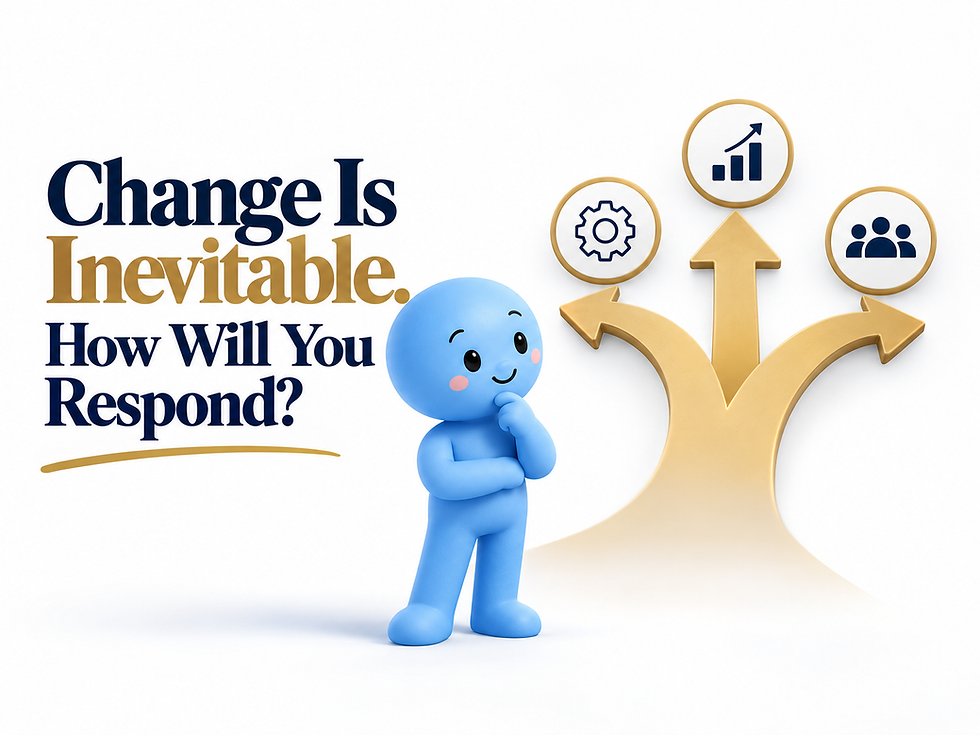
Business owners, executives, leaders, and managers: your business is going to evolve whether you are ready for it or not. Sometimes change happens gradually, almost without you noticing. Sometimes it happens suddenly because of an unexpected event, a major decision, or something completely outside your control. It might affect one part of your business, or several parts at the same time. Either way, change is part of running a business. You can deal with change, or change will deal with you.
Why We Resist Change
At the most basic level, we resist change because we are wired to avoid pain. As human beings, avoiding pain and seeking safety are deeply rooted in how we function. Change can represent uncertainty, loss, discomfort, or the possibility that something we've relied on won't work the way it used to. Even when we know the change may ultimately be better for us, our first instinct can still be to protect ourselves from what might hurt.
In business, that can show up in a lot of ways. Maybe you're afraid of losing control. Maybe you're worried about disrupting your employees. Maybe you've used the same process for years and changing it feels like creating more work. Maybe you know you need to hand something over to someone else, but you're uncomfortable not being the person in charge of it. Sometimes we aren't resisting the outcome, we're resisting what we think we might have to give up to get there.
That's why knowing a change is necessary doesn't always make it easy to make the change. We can understand something logically and still resist it emotionally. The question then becomes: Are you protecting yourself from temporary discomfort, or are you protecting the business from a problem that needs to be addressed?
Look at the Desired Outcome
You can't figure out where you are going until you understand where you have been. Before you decide what needs to change, you have to know where you're trying to go. What is the desired outcome? Maybe you want a business that can operate without you every minute of the day. Maybe you want to increase sales, improve customer satisfaction, reduce employee turnover, strengthen your systems, or finally be able to take a vacation without your phone becoming your lifeline.
Once you know where you want to go, you can look honestly at whether the choices you're making are actually moving you in that direction. You can't expect to reach your desired outcome if your choices are working against it. Sometimes the problem isn't the goal. The problem is that the things you're doing to reach the goal don't actually support the outcome you want.
Think of It Like an Equation
I like to think about this like an equation. If you're trying to get to two, but the variables you're putting into the equation keep giving you one, something has to change. Maybe it's your process. Maybe it's your people. Maybe it's technology, your financial structure, your management style, or the way you're approaching the problem. Whatever it is, you have to identify the variable that isn't producing the result you need.
The same thing applies outside of business. The car didn't get fixed? Try something different. The cake came out flat? Change an ingredient. You can't keep using the same variables and expect a different result. And sometimes the first change doesn't work either. That's okay. Try again. Change another variable. You are learning from the result and using that information to make the next decision.
Sometimes You Have to Get Out of Your Own Way
This is where things can get really difficult. You may be holding onto something because you've always done it that way. You may be reluctant to hand something over because you don't know whether someone else will do it correctly. You may know a process isn't working anymore, but changing it feels like more work than continuing to deal with the problem.
At some point, you have to be willing to step back and ask yourself an uncomfortable but important question: Is what I'm doing actually getting me where I want to go? If the answer is no, something in the equation has to change. That doesn't mean you have to throw everything away or admit that everything you've done before was wrong. It means you have to be willing to look at the situation honestly and make an adjustment.
And if you don't know what needs to change, that's okay too. Learn. Research. Look at the data. Ask questions. Get another perspective. Sometimes you simply need someone outside of the situation to help you see the variable you couldn't see because you were too close to it.
Your Business Will Evolve. Evolve With It.
You cannot control every change that happens around your business. Employees will change. Customers will change. Technology will change. Regulations will change. Your business will grow, slow down, shift directions, and sometimes surprise you completely.
What you can control is how willing you are to recognize what is happening and respond to it. You don't have to predict every change, and you don't have to get every decision right the first time. But you do have to be willing to adapt when the result you're getting isn't the result you need. Your business is going to evolve either way. The question is whether you're going to evolve with it.
IntegriLytics, Inc. helps small businesses with accounting, human resources, and operational oversight. Helping business owners look at the whole picture, not just one isolated problem, and build systems that support where the business is going. Serving businesses nationwide with remote and in-person support.


Comments